



Longwave Radio (LW / LF)
Longwave (LW) is a radio frequency band characterized by very low frequencies and extremely long wavelengths. Depending on the language and technical context, you may encounter different abbreviations:
- LW (Long Wave) — common English-language term
- LF (Low Frequency) — official ITU classification
- ДВ — Russian abbreviation (“Long Waves”)
- GO (Grandes Ondes) — French term
In technical documentation, LF is typically used, while LW is more common in consumer radio contexts.
Longwave broadcasting traditionally uses AM (Amplitude Modulation).
Technical Characteristics
- Frequency range: 30–300 kHz
- Wavelength range: 10 km to 1 km
You can convert frequency (in kHz) to wavelength (in meters) using a simple formula:
Wavelength (meters) = 300,000 / Frequency (kHz)
For example:
- 150 kHz → 2000 meters
- 300 kHz → 1000 meters
Broadcasting Sub-Band
In Europe, parts of Asia, and North Africa, the longwave broadcasting band spans approximately:
148.5–283.5 kHz
Signal Propagation
Longwave signals primarily propagate as ground waves, meaning they travel along the Earth’s surface and can follow its curvature. This allows them to:
- bend around terrain,
- travel beyond the visual horizon,
- cover very large geographic areas.
Ionospheric reflection is weak and unstable compared to shortwave frequencies. However, nighttime conditions may slightly enhance propagation.
I remember radio receivers that had a longwave band, and you could pick up some stations on a home radio. That was about 30 years ago.
This is one of the receivers I had as a child, “Меридиан РП 308”
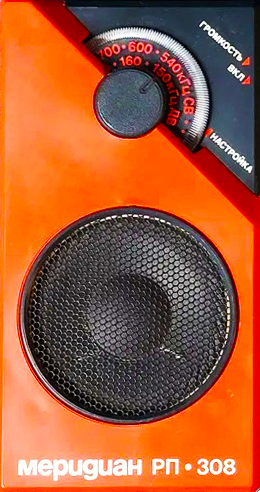
Now, there are almost no radio stations broadcasting in this band. Most countries on the planet have stopped broadcasting longwave radio stations. And if you want to pick up a station on longwave, it won’t be easy. Your receiver might simply not have this band.
Why Longwave Broadcasting Is Disappearing
Longwave radio has almost vanished worldwide. In most countries, LW broadcasting has been discontinued.
The primary reason is economic.
1. High Power Requirements
Longwave broadcasting requires extremely powerful transmitters. The higher the power, the larger the coverage area.
Typical coverage ranges by transmitter power:
| Power | Approximate Coverage |
|---|---|
| 50 kW | 300–500 km |
| 150 kW | 600–900 km |
| 500 kW | 1000–1500 km |
| 1 MW | 1500–2000 km |
Nighttime coverage can increase by 20–50%.
2. Large Antenna Structures
Because wavelengths are measured in kilometers, antennas must be very large.
Typical mast heights:
150–300 meters
Even at 300 meters, the antenna is only a fraction of the wavelength, which reduces efficiency and requires even more transmission power.
3. Additional Influencing Factors
Coverage is also affected by:
- terrain conductivity,
- proximity to seawater (which improves propagation),
- weather conditions,
- atmospheric noise levels.
The Other Major Drawback: Audio Quality
Beyond energy consumption, longwave suffers from:
- narrow bandwidth,
- significant atmospheric noise,
- electrical interference,
- limited audio fidelity.
Compared to FM, DAB, and internet streaming, LW audio quality is clearly inferior.
As technology advanced, radio broadcasting shifted toward:
- FM for higher sound quality,
- Digital broadcasting (DAB/DRM) for spectral efficiency,
- Internet streaming for global accessibility.
Where Longwave Is Still Used
Despite its decline, longwave has not disappeared completely.
1. Large-Coverage National Broadcasting (Limited Cases)
A small number of countries — typically those with large territories — have maintained longwave transmitters due to their ability to cover vast areas with a single transmitter.
2. Military Applications
Longwave and nearby LF/VLF frequencies are still used for:
- communication with submarines,
- strategic backup communication systems,
- resilient low-frequency signaling.
Low frequencies penetrate seawater better than higher-frequency radio signals.
3. Navigation and Timing Services
Longwave is used for:
- radio beacons,
- time signal transmission,
- frequency standard distribution.
These systems are valued for their reliability and independence from satellite infrastructure.
4. Emergency Backup Infrastructure
Some countries maintain decommissioned longwave transmitters in reserve.
In extreme situations — such as:
- large-scale infrastructure failure,
- cyberattacks,
- satellite disruption,
- national emergencies —
longwave broadcasting can serve as a robust, hard-to-disable communication channel.
Why Longwave Still Matters
Longwave represents an earlier era of radio engineering — one focused on:
- maximum coverage,
- infrastructure-level reliability,
- simplicity and robustness.
While economically inefficient for modern entertainment broadcasting, LW remains relevant in niche applications where resilience matters more than sound quality.
In Ukraine, there are no radio stations broadcasting on longwave. However, two foreign radio stations can be received in Ukraine. These two stations cover almost all of Ukraine, including the occupied territories.
“Radio Antena Satelor” broadcasts from Romania. The broadcast frequency is 153 kHz. The transmitter power is 200 kW.
“Polskie Radio Jedynka” broadcasts from Poland. The broadcast frequency is 225 kHz. The transmitter power is 1000 kW.
I can’t confirm this 100%, as I don’t currently have a receiver capable of receiving longwave.

I gotta bookmark this website it seems extremely helpful invaluable
wish you best and best
Fantastic goods from you, man. I’ve take into account your stuff previous to and you are just extremely wonderful. I really like what you’ve bought right here, really like what you’re stating and the best way by which you assert it. You make it entertaining and you still care for to stay it sensible. I can not wait to read far more from you. That is actually a great web site.